





RICS publishes Land Measurement for Planning and Development Purposes
|
The guidance represents international best practice for land measurement.
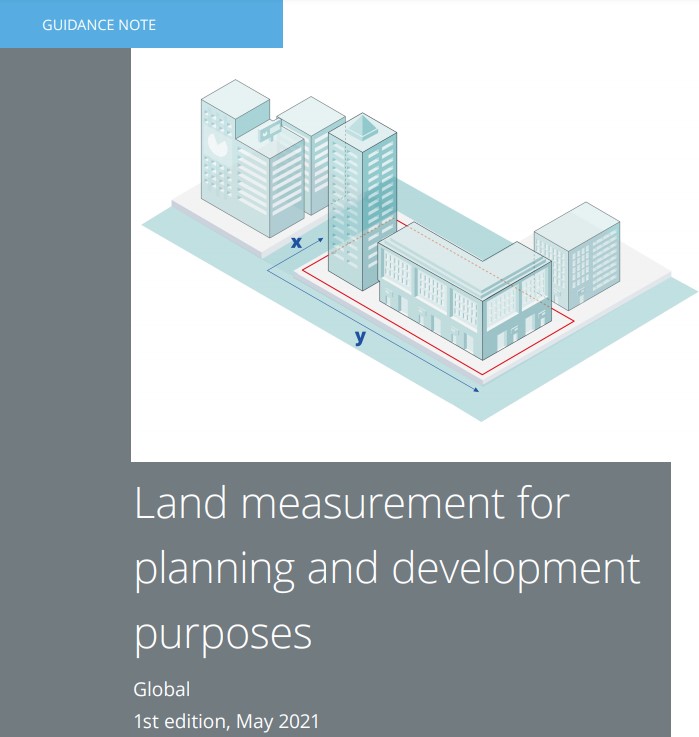
In May 2021, guidance on the measurement of land for development projects such as new housing and commercial development was published by the Royal Institution of Chartered Surveyors (RICS) which defines common measurements used across the built environment and associated metrics such as density.
The guidance is available and will be used by planners, surveyors, developers, designers, government and legal administrators around the world.
Titled Measurement of Land for Planning and Development Purposes, it provides clear definitions for measurements widely used in the property and built environment sectors, advocating consistency worldwide. Five core definitions have now been formalised by RICS to assist with the global measurement of land. They are:
- Land Ownership Area (LOA): an area of land, measured on a horizontal plane, which is held in a single legal interest or title by one or more legal owners, which may be the subject of a proposed or actual sale, letting or other disposal, valuation or compulsory purchase, and which may comprise all or part of that single legal interest or title.
- Site Area (SA): the total land area on which development authorisation is sought, measured on a horizontal plane.
- Net Development Area (NDA): the extent of the Site Area upon which one or more buildings or other operations and their ancillary space can be built, measured on a horizontal plane.
- Plot Ratio (PR): the ratio of total development floor area to SA. Development floor area may be measured as gross external area (GEA) or gross internal area (GIA) but whichever is used or modifications of them should be clearly stated.
- Floor Area Ratio (FAR) and Floorspace Ratio (FSR) are similar terms, used interchangeably in some jurisdictions to reference the same point. For consistency, PR should be used wherever possible. Where jurisdictional requirements are for the use of either FAR or FSR, PR should be reported as well.
- Site Coverage (SC): the ratio of ground floor area (measured in accordance with GEA) to SA, expressed as a percentage.
A key difference with the guidelines is that calculations of density should now always be expressed in terms of Gross Density (based on SA), rather than on a Net basis, with Net Density providing an additional and complementary metric for understanding the intensity of development of a site.
The formal Guidance for Land Measurement can be read here.
The guidance is lead-authored by one of Britain's foremost urbanists, Chartered Surveyor and Town Planner Jonathan Manns, Executive Director at Rockwell, who said:
"Land measurement is a vital day-to-day component of real estate and this Guidance introduces, for the first time, clear and fixed definitions to assist with that process.
"In doing so it establishes international best practice to be used whether buying, selling, evaluating, valuing or developing land.
"This has the potential to profoundly improve consistency, once in regular use, to the benefit of both professionals and the general public alike, in countries around the world."
With over 130,000 qualified and trainee professionals, the RICS promotes and enforces the highest international standards across the built and natural environment.
Tony Mulhall MRICS, Associate Director of the Land Professional Group at the RICS, stated:
"This guidance offers a consistent way to measure land – whether that's delivering desperately needed homes, new infrastructure or preparing vacant spaces for future development."
This article originally appeared on the CIAT website under the headline, 'RICS launches new global guidance for "Land Measurement"'. It was published on 25 May 2021.
--CIAT
[edit] Related articles on Designing Buildings Wiki
- CIAT articles.
- New Rules of Measurement.
- RICS code of measuring practice.
- Royal Institution of Chartered Surveyors RICS.
- Site surveys.
- Standard Method of Measurement SMM7.
[edit] External resources
Featured articles
Check out some of the best features and news from Designing Buildings as well as key stories from around the web.

Bringing together expertise and creating cultural benefits.

CIOB celebrates positive Ofsted report.

The Building Safety Regulator announces a call for evidence.

Government approach could undermine delivery and regeneration.
World's first mass timber data centre.

The overlooked environmental aspect of data centre development.
Introduction to radon awareness

New technical information sheet published by CIOB.

Updated supplier guide can help electrical contractors engage with NHP.

CIAT confirm the winners of the 2026 architectural technology awards.

Government launches a one stop shop for flood preparedness.

Sir Edwin Lutyens: Britain's greatest architect? Book review.

CIOB publishes free template to help assess and manage risks.
ECA's reflections on Party Conference season

Burnham wants to be confident of winning before asking for a fresh mandate.
Comments